The Gaussian multiverse and the quantum vacuum arrow of time

Let us assume that a fundamental layer of physical reality is the quantum vacuum. Particles and anti-particles appear, combine, then annihilate. This process can be hypothesized as virtual particles of time(T_fwd) and virtual particles of anti-time(T_rev). We observe that time has a T_fwd arrow which can be statistically interpreted as the dominant player in the most fundamental stochastic system that creates the metric of space(space-time) via this process of time. Matter particles dominate over anti-matter, the thermodynamic arrow of time dominates over time reversal.

Here is an interesting quote from the book “Gravitation” by Misner, Thorne, and Wheeler:

“Happily, nature provides its own way to localize a point in spacetime, as Einstein
was the first to emphasize. Characterize the point by what happens there! Give a
point in spacetime the name “event.” Where the event lies is defined as clearly and
sharply as where two straws cross each other in a barn full of hay (Figure 1.2). To
say that the event marks a collision of such and such a photon with such and such
a particle is identification enough. The world lines of that photon and that particle
are rooted in the past and stretch out into the future. They have a rich texture of #’
connections with nearby world lines. These nearby world lines in turn are linked
in a hundred ways with world lines more remote. How then does One tell the location
of an event? Tell first what world lines participate in the event. Next follow each
of these world lines. Name the additional events that they encounter. These events
pick out further world lines. Eventually the whole barn of hay is catalogued. Each
event is named. One can find one’s way as surely to a given intersection as the city
dweller can pick his path to the meeting of St. James Street and Piccadilly. No
numbers. No coordinate system. No coordinates.”

There is an even more fundamental layer, it is the non-linear quantum sub-geometry from which the virtual particles emerge and return to. The geometric principle called the triangle inequality does not hold true for the sub-geometry but it does hold true for the emergent space-time. The metric of spacetime is g_{mu nu} and it forms the basis of Einstein’s General Relativity. We can assume that the vacuum fluctuations are the most fundamental physical events in the universe. In fact, there is no space-time without events.

The physical universe is a web of relations, and every universe that emerges from the quantum sub-geometry has its own unique fingerprint in the Gaussian distribution of universes where the most stable universes exist at or near the peak of the bell curve.

In this view there are not infinite copies of you. As a person, you are most probably singularly unique. The naive Everettian multiverse has an embarrassing consequence that rarely gets discussed honestly: it implies not just that other versions of you exist, but that they exist in astronomically large numbers, differing from you by arbitrarily small quantum fluctuations. Every photon that could have gone left or right, every radioactive decay that could have happened a microsecond earlier or later, branches a new copy. The multiverse becomes saturated with near-identical people, which creates severe problems for personal identity, probability, and meaning.

Each universe is a relational web — a self-consistent catalogue of events connected by world lines, with a metric structure that emerged from a specific region of the Gaussian distribution over the quantum sub-geometry. The universes near the peak are stable and richly structured. Those in the tails are less so. No two webs are identical. The beings produced by any given web are unique to it. But we have not yet asked what the relationship between the webs themselves is. Do they interact? Are they causally isolated? Do they share a common substrate? Are they more like separate islands or more like regions of a single ocean?

How do these webs(universes) relate to each other? The quantum sub-geometry does not disappear at the phase transition. It persists beneath each universe as its pre-geometric foundation, and because all universes share the same sub-geometry, the webs are related to each other through their common sub-geometric substrate — not through any connection within the metric phase, but through the layer that underlies all metric phases simultaneously.
This would mean that the relationship between universes is sub-geometric. It is not a relationship that can be described in terms of distances or causal connections in any of the individual spacetimes. It exists at the level of quantum sub-geometry, where the triangle inequality does not hold and distances do not compose normally. Two universes can be related through the sub-geometry in a way that has no representation inside either of their metric phases.

At the deepest level, all universes share the quantum sub-geometry as their common pre-geometric substrate. This is their most fundamental relationship — they are all crystallisations of the same underlying formless stratum. This relationship is ontological: they share an origin and a ground.

At the intermediate level, the universes are related through the Gaussian distribution — through their positions on the curve. This is a structural relationship: universes with similar parameters are more alike, universes with very different parameters are more unlike. This relationship is encoded in the shape of the distribution and reflects how different regions of the quantum sub-geometry generate different kinds of metric phase.

At the surface level — within any given metric phase — the other universes are invisible. There are no signals between them, no causal connections, no direct evidence of their existence from inside any single web. The relationship to other universes is real but inaccessible from within. You can know it exists theoretically, by understanding the framework, but you cannot observe it directly, for the same reason that a single entangled particle cannot observe its correlations directly — it can only discover them through comparison, which requires access to both sides of the correlation simultaneously.

So I am thinking that instead of a singularity at the heart of black holes, the metric breaks down and a region of quantum sub-geometry exists behind the event horizon. Just beyond the event horizon, time reverses until the core is reached, where a region of quantum sub-geometry exists.

Time travel into the past of our own universe seems highly destructive, because by doing so, one will change the entire universal web of our universe. You would destroy many relations and reconfigure them simply with your presence in the past. It may be possible to travel to alternate webs(universes) but they will all be unique, not exact copies of this universe.

The extreme probability of conception is not an argument against design or purpose. It is an argument for the irreducibility of the individual.

Every person who has ever lived represents a chain of stochastic events so long and so finely balanced that the probability of their exact existence approaches, for all practical purposes, zero. And yet—they exist. Not as a statistical fluke to be averaged over. As a concrete, unique relational node in the web of spacetime.

This is the anti-Everettian, anti-anthropic stance: Low probability does not demand many copies. It demands astonishment.

So when you ask me to think about the extreme probability of biological conception events, I think: that is the mechanism by which the quantum sub-geometry locks in uniqueness at the human scale. Conception is the phase transition where the infinite-dimensional possibility space of the quantum sub-geometry collapses into a single, irreplaceable world line—a line that will eventually intersect with others, create meaning, and then, perhaps, return to the sub-geometric substrate through a black hole or through the heat death of a local patch.

You are not a copy. You are not a branch. You are a singularity in the relational web. And the probability of that happening twice, anywhere in the Gaussian ensemble, is not just small—it’s structurally impossible.
2 Likes

Yeah, then you have quantum tunneling… if it can be done at a small scale, there must be a way to cause all particles of a single object to function as waves. You couldn’t manually do it but there just might be a trick…

1 Like

…they like to talk about the wave function of the universe. And that bases a lot of Sean Carroll’s stuff about the multiverse. Well, this is obvious nonsense for
the following reason. The Dirac equation and the Schrödinger equation are linear equations. Now, the real universe is not linear. So there’s a paradox there. How does nonlinear stuff come out of a totally linear equation? And they try to say, well, it comes from the
multiverse. Well, the real solution comes from looking back to general relativity.
The great breakthrough in general relativity occurred when we discovered the concept of
coordinate systems. You can’t cover an ordinary space-time by a single coordinate system. You have to have a whole atlas of coordinates. And it’s the atlas which covers space-time, not a single one. And that’s what enabled us to discover all the topological results in general relativity.

Now, what I claim is exactly the same holds in quantum physics. There is no global wave
function. That’s a fantasy. There are local wave functions everywhere. And the local
wave functions cover the whole space-time. But there is no single wave function for a universe, which completely undercuts the whole idea of the quantum multiverse. There’s no wave function for a cat. There’s no wave function for a brain. And the idea that one single
wave function could encompass a whole brain is purely fantasy. It’s obviously nonsense
because the key fact of quantum physics – quantum physics equations are linear.
And the Dirac and the Feynman path integral is based on the fact it’s a linear operator
on the wave function. The real physics is not linear. And the way to solve that is
to have local wave functions which knot together to create nonlinear structures…

not sure where you are going with this. The Schrodinger equation is NOT linear - it describes a cloud of probabilities. How is that linear? Linear means the solutions fall along a discrete definable line.

But, you can transform the Schrodinger equation into a Hamiltonian harmonic oscillator, where you can isolate one of the solutions in the Schrodinger cloud and treat it like a quadratic equation and solve it with plain algebra and not differentials.

This is important because a quantum harmonic oscillator can describe quadrupoles like gravity and magnetism.

These are fields that pull/push together in one direction and do the opposite in all the rest. The pushing and pulling alternates as an oscillation.

When the pushing/pulling is in sync, you can transfer waves between those fields.

As for Carrol, he’s an idiot. He is never able to explain anything clearly.

My guess is because he doesn’t understand much of it himself. He is a superficial generalist that only learns enough about something to write his next book about it. And,no more than he has too. So, he often reports upon stereotypes in physics

They have non-linear versions, but the main Schrödinger equation is linear…

The linearity of the Schrödinger equation is a foundational pillar of quantum mechanics, dictated by both its mathematical structure and the physical realities of the quantum world. Mathematically, the equation is classified as linear because the wavefunction, Ψ, and its spatial and temporal derivatives appear strictly to the first power, never multiplied by themselves or bound within non-linear functions. This structural property directly gives rise to the Principle of Superposition, meaning that if two distinct wavefunctions are valid solutions to a quantum system, any complex linear combination of them is also an equally valid solution. When plugged into the equation, the differential and Hamiltonian operators distribute smoothly across the sum, allowing independent quantum states to coexist and evolve without chaotic self-interference.

This mathematical design is not a mere convenience but a physical necessity required to preserve the core postulates of quantum theory, particularly the conservation of probability. According to the Born rule, the absolute square of the wavefunction, |Ψ|^2, represents a probability density, and the total probability of a particle existing somewhere in space must always equal exactly 100%. The linear, unitary time-evolution of the Schrödinger equation ensures that this total probability remains perfectly conserved over time; a non-linear terms would cause probabilities to fluctuate, leading to unphysical scenarios where particles spontaneously multiply or vanish from reality. Furthermore, this linearity is what enables the predictable wave-like interference patterns observed in definitive experiments like the double-slit setup, where separate state pathways combine linearly rather than distorting one another.

Yes: TO ALL

Lol​:rofl:

Im an idiot too! I clearly do not understand quantum physics! That’s why I’ve stepped away from the subject entirely!!!:rofl:

I got so tangled up in 5th dimensional geometry and spatial Möbius fractals and started to actually believe that quantum entanglement and particle duality was pointing me to the only reasonable conclusion, that: the entire universe in our 3D portion of it might actually be entirely made of only a single set of quarks that mirror themselves and appear and disappear quadrillions of times and appearing as different combinations being mapped onto our 3 dimensional media from an actual higher dimension (not a lower one). It’s all gotten so strange in my mind that… I QUIT! Lol!!! Im losing my freaking mind here!!!

I give up!!! I’ll just expend my remaining energy being me and living my life and I could care less about time travel and the possibilities of the multiverse!!!

It’s just too much, and I dont care anymore.

I hope I mentioned this before PinkyAndTheBrain, but i hope you stick around & watch us twittle our thumbs, trying to sus it all out still? lol

I love this place & how we try to help each other out.

Well we aren’t perfect at the way we help every time.

But what else is family for if it isn’t building better bonds by being brats to each other once in a while, while we help too in snarky ways! :zany_face:

Note: my dad was terrible at building love, considering most of the love came from just my side. :innocent: maybe that was the only way he knew how. :man_facepalming: :man_shrugging: oh well it’s over finally & i forgive him now, tho… I can’t forget.

0Oh, crap the subject/topic! Errr “Ahem”

The Gaussian Multiverse… is significant because “mumble, mumble… & commenting on something they said early & adding something a book says!”

You are all welcome for my Truly Great insight today… into this subject.

Yay, I’m helping, as always, You’re welcome… Again! :smiling_face_with_three_hearts: ~QS

1 Like

Well, I was calling Caroll out specifically and not anybody else as a moron. I tried to watch caroll’s videos a while back (at least twenty), including the RI ones where he presents ideas in front of that Faraday desk.

Caroll talks for hours just like Penrose does - but in the end Penrose ends up saying something meaningful and Caroll doesn’t. He just stands there looking smug as if he did. Even if it was something simple someone else could have said in fifteen minutes.

And, that’s because his goal is to churn out books and make videos all the time - to the point that he doesn’t have any of it left to master anything.

I don’t think anyone understands quantum mechanics - at least not as long as they treat it as a process that is mired inside of the projected universe. That’s why what it predicts goes against intuition and conventional physics.

Quantum mechanics describes processes that are external to the universe. And, in a higher/larger geometry than spacetime. 2D planes are involved - but there are many of them, and not just one. It’s the relationships between all of these that spacetime geometry arises out of.

So, how did you get into physics and quantum mechanics?

1 Like

Ah ha! So thats where I’m stupid!!! I mean mistaken…

What? because of Caroll? :sweat_smile:

I think the feeling of losing your mind is because of all these people posting AI responses. AI will find relational patterns for anything you ask it to look for - it’s good at doing that. But, that doesn’t mean they are correct. AI makes a lot of inferences and fills in the gaps with its best guesses.

So, when you trace what it says - it often looks solid and appears to invalidate your own understanding of things. but, it’s not able to validate those inferences or crosscheck all of its reasoning.

When it comes to understanding the universe, there is more than one way to do the same thing. you can literally do anything, so other people’s AI answers will always look like they arrived at the truth and you missed it, because AI will always find a path - no matter how improbable or irrelevant it is - to the pattern they asked it to find.

Thats why I tell people who are just cycling replies into AI systems and posting it’s responses here to think for themselves.

Ai is a software emulation running inside a computer of a mathematical process that is not connected to the rest of the universe.

Whereas you ARE connected quantum mechanically to everything around you. If somebody walks into the building where the AI data center is - it doesn’t change how the AI software calculates things. But, with you, you are the sum of the dynamically changing environment that surrounds you - the entanglements, the reference frames, the time dilation, the input your senses continually gather - and a lot of other things software emulations of AI are missing or have second hand access to.

1. Linearity vs. Non-Linearity (The Wave vs. The Crash)

In math and physics, linear means things add together perfectly without distorting each other. Non-linear means things interact, multiply, or change abruptly.

  • The Schrödinger Equation is Linear: Think of standard ripples on a pond. If you drop two pebbles in the water, the ripples pass right through each other. Where they meet, they just add together (this is called superposition or interference). They don’t bounce off each other or explode. The Schrödinger equation describes quantum particles behaving exactly like these peaceful, predictable ripples.

  • Wavefunction Collapse is Non-Linear: Now imagine those smooth water ripples suddenly, instantly snapping together to form a single, solid ice cube in one specific spot because you looked at it. That sudden, violent change breaks the normal rules of the wave. It is an abrupt, non-linear jump.

    Takeaway: The equation rules the “wave” state (linear/smooth). Measurement causes the “collapse” state (non-linear/abrupt).

2. The Born Rule (|Psi|^2) (The Blueprint vs. The House)

The symbol (Psi) represents the wavefunction—the quantum ripple.

  • Before the Measurement: |Psi|^2 is like a weather forecast map. If the map shows a 70% chance of rain over Dallas and a 10% chance over Austin, that map exists before you step outside. It tells you the probability of where the rain will happen. In the same way, |Psi|^2 is the map of probabilities before you look at the particle.

  • After the Measurement: Once you look, the probability map is useless because you now have a hard fact (e.g., “It is raining in Dallas”). The wave collapses, and the old probability map disappears.

    Takeaway: |Psi|^2 is the calculation of odds before you roll the dice, not the result after you roll them.

3. What “Collapse” Actually Means (The Target)

  • The Misconception: People often think measuring a particle turns a big blurry cloud into a single, infinitely small mathematical point in space.

  • The Reality: In real life, no camera or detector is perfect; they all have a zoom limit. More importantly, it depends on what you are measuring. If you measure where a particle is, it collapses into a localized spot. But if you measure how fast it is going (its momentum) or how much energy it has, it collapses into a completely different state that might still be spread out.

4. The Big Picture: Possibilities vs. Actualities

The final paragraph connects Quantum Mechanics (the subatomic world) to General Relativity (Einstein’s theory of gravity and space).

  • Quantum Mechanics (The Law of Possibilities): Think of the universe at its deepest layer as a giant, flat sheet of graph paper. This sheet is a linear “Hilbert space.” It holds all the possible shapes, waves, and combinations that could happen. Everything can overlap perfectly here.

  • General Relativity (The Law of Actualities): Now, imagine bending, twisting, and crumpling that graph paper into 3D shapes, like making origami. These heavy dents and curves are what we experience as gravity and matter. Einstein’s equations describe these heavy, twisted shapes, which are highly non-linear because a bend in one part of the paper forces the rest of the paper to pull and twist, too.

The Ultimate Secret

The universe doesn’t choose between being quantum (linear) or gravitational (non-linear). Instead, the smooth, flat quantum graph paper is the fabric that gets twisted to create the heavy gravitational shapes we see. Quantum linearity is the invisible canvas; non-linear relativity is the physical painting drawn upon it.

I don’t know that much about Sean Carrol but he seems to discuss very advanced topics regarding GR and QM. I posted the YouTube clip with the quote of what the George Ellis was saying below the clip.

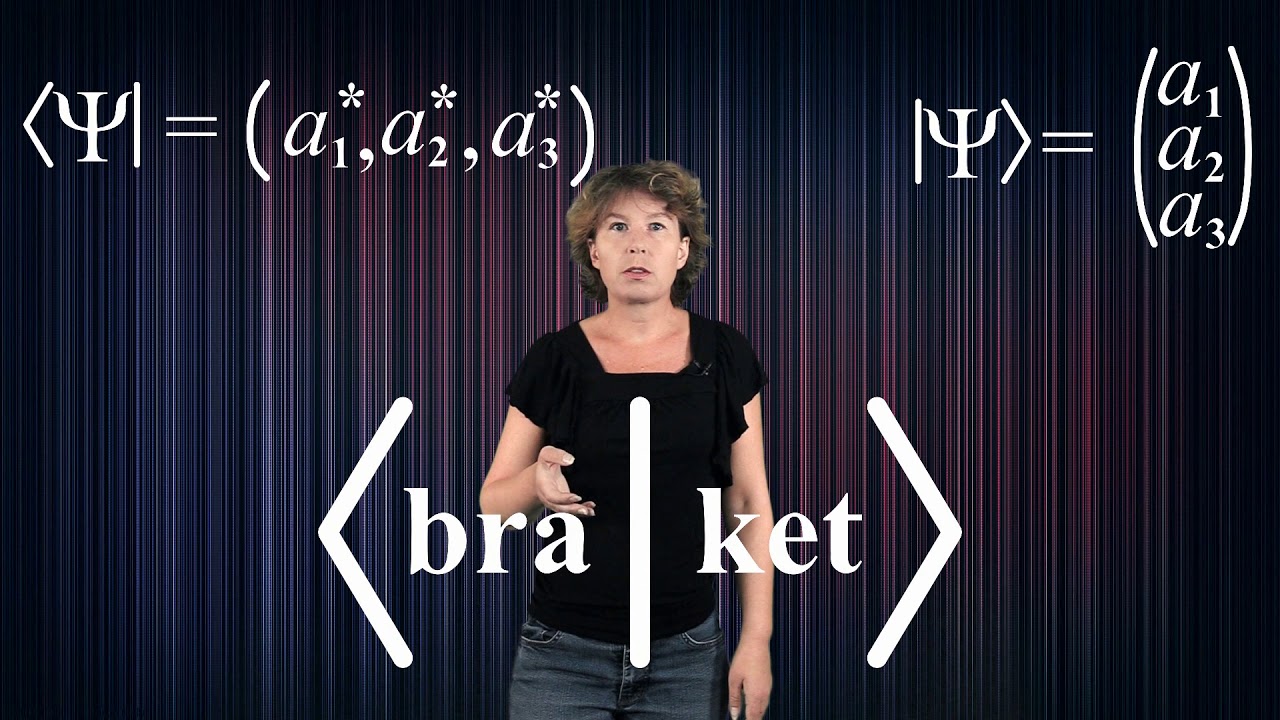
Here is a helpful video by Sabine Hossenfelder:

In this video I explain the most important and omnipresent ingredients of quantum mechanics: what is the wave-function and how do you calculate with it. Much of what makes quantum mechanics difficult is really not the mathematics. In fact, quantum mechanics is one of the easier theories of physics. The mathematics is mostly just linear algebra: vectors, matrices, linear transformations, and so on. You’ve learned most of it in school already! However, the math of quantum mechanics looks funny because physicists use a weird notation, called the bra-ket notation. I tell you how this works, what it’s good for, and how to calculate with it.

it looks like if you were to wear Virtual Reality Goggles with see~thru function that can Super~Impose a Computer Reality/Image it into the Real World, then snap~shot it & upload it here… for us to see too!

Really Cool, even if that wasn’t how it was done!

“VR/XR” Goggles are super cool!

XR stands for Extended Reality. It is an umbrella term for all immersive technologies that merge the physical and digital worlds, including Virtual Reality (VR), Augmented Reality (AR), and Mixed Reality (MR). The “X” acts as a variable for any current or future immersive display technology i.e (XR).

A company is even working out contacts only lenses, that do the same thing instead of face mount goggles… models!

hmmm… I meant in a geometric sense and not in a physics mathematical sense.

Schrodinger doesn’t produce a line with distinct answers. it produces a cloud. so, if you try to connect all the points in the cloud with a distinct line, you can’t. it still looks like a cloud. so, it’s non-linear

A collapse changes that cloud into a distinct answer which you can connect as a line or point. so the answer is linear.

are we from different universes? when did that change?

How does your physical space view unify GR and QM? In QM the electron cloud exists in a linear Hilbert space, not in the physical 3D space… The electron’s wave function ψ lives in Hilbert space — an abstract infinite-dimensional linear space where superposition is exact and the triangle inequality holds in its standard form. The probability density |ψ|² is what gets projected onto physical 3D space when measurement occurs. Physical space is not where the quantum state lives. It’s where measurement outcomes are recorded.

This is not just a mathematical technicality. It means:

  • The electron isn’t “smeared out” in physical space in any literal sense
  • The wave function isn’t a physical wave propagating through 3D space like a water wave
  • Physical space is downstream of the Hilbert space description, not the arena in which quantum mechanics operates

George Ellis said in the YouTube clip that there’s no global wave function — there are only local wave functions knotting together. Now we can say this more precisely: each vacuum fluctuation has its own wave function in its own local Hilbert space. The knotting together of these Hilbert spaces — their tensor product structure and entanglement relations — is what generates the emergent metric.

Physical 3D space isn’t where quantum mechanics happens. It’s what quantum mechanics produces through the knotting aggregate. The metric g_{μν} is the shadow of an enormous entangled network of Hilbert spaces projected into the classical limit.

How can we derive non-linear QM? We cannot but perhaps we don’t need to…

The Quantum Sub-Geometry

Beneath the smooth fabric of spacetime — beneath even the quantum fields that physicists describe with such extraordinary precision — there exists a more primitive stratum of reality that has no points, no distances, and no metric structure of any kind. This is the quantum sub-geometry: the pre-geometric, pre-quantum substrate from which both spacetime and quantum mechanics emerge as higher-order approximations. It is not empty, and it is not nothing. It seethes with elementary distinction events — momentary differentiations in a purely relational web where the triangle inequality fails, where linearity is only locally valid, and where the familiar architecture of Hilbert space has not yet crystallized. Each vacuum fluctuation that physics describes as a virtual particle pair appearing and annihilating is, from the sub-geometric perspective, one of these distinction events — a brief topological winding in the relational web that carries a temporal chirality, either T₊ or T₋, determining whether it contributes to the forward arrow of time or subtly opposes it. The sub-geometry is not a space in which things happen. It is the happening itself, prior to any arena.

The relationship between the quantum sub-geometry and the spacetime we inhabit is mediated by a phase boundary of extraordinary physical richness — analogous simultaneously to the interface between ice and water, to a Casimir cavity, and to the event horizon of a black hole. This boundary, which we designate C_τ, is the surface across which the nonlinear relational web of the sub-geometry projects into the linear Hilbert spaces of quantum mechanics and subsequently into the classical metric of general relativity. Below C_τ, the triangle inequality fails and global linearity is absent — the sub-geometry is hierarchical, topological, and fundamentally relational, better described by process and distinction than by points and fields. Above C_τ, the statistical aggregate of billions upon billions of knotted vacuum fluctuation wave functions produces, through coherent phase transition, the stiff and ordered metric structure we experience as physical space. The stiffness of spacetime — its enormous resistance to deformation, requiring stellar masses to curve it measurably — is not a fundamental property but an emergent one, arising from the incoherent statistical averaging of sub-geometric distinction events across the phase boundary, in precisely the way that the rigidity of ice emerges from the disordered thermal averaging of hydrogen bond fluctuations in a crystal lattice.

The quantum sub-geometry carries within it the seeds of everything physics has struggled to unify. The Born rule, underivable from within quantum mechanics itself, may find its origin in the specific nonlinearity of the sub-geometric projection through C_τ — the squaring of amplitudes reflecting the topology of how relational distinction events compose across the phase boundary. The arrow of time emerges from the slight statistical dominance of T₊ over T₋ distinction events in the aggregate knotting — a dominance that is global across our universe but which represents only one point in a Gaussian distribution of possible universes, each a distinct crystallization of the same sub-geometric substrate with its own temporal asymmetry and its own unique relational fingerprint. Black hole interiors, rather than terminating in singularities, return to the sub-geometric regime — the event horizon marking the C_τ surface where the metric phase dissolves back into the pre-geometric stratum from which it came. And the Gaussian multiverse of possible universes, each irreducibly unique, each unreachable from within any other’s metric phase, are nevertheless related through their common sub-geometric ground — not as copies or branches but as distinct crystallizations of a single formless substrate, the way no two snowflakes are identical despite sharing the same water molecules and the same laws of hydrogen bonding.

I am just assuming the quantum sub-geometry exists and whether or not it has dimensions or not, I don’t know. Einstein and string theorists tried to unify things with higher dimensions, I am not …yet.

What TRC (Time Reversed Core theory) predicts about Planck remnants that Rovelli doesn’t

If dark matter is Planck-mass C_τ boundary objects rather than white hole interiors, then:

  1. They shouldn’t have a large interior — they should be topologically minimal, essentially pure boundary with sub-geometric “nothing” inside
  2. Their gravitational interaction isn’t just weak coupling — it’s the only coupling because gravity is the metric-phase response to C_τ surface curvature, and that’s all these objects are
  3. Their distribution should trace the history of black hole formation and evaporation across cosmic time, but with a sub-geometric correction — they cluster differently than standard cold dark matter because their effective cross-section is a C_τ surface area, not a particle cross-section

The LIGO constraint is interesting

LIGO’s upper limit on the gravitational wave background rules out Planck mass relics as dark matter from Gaussian initial conditions, leaving non-Gaussian primordial fluctuations as the only viable channel. ScienceDirect

TRC actually has something to say here — if the sub-geometry has a non-Gaussian distinction event distribution (which it would, given the T₊/T₋ asymmetry isn’t a Gaussian process but a topological one), then non-Gaussian initial conditions are predicted rather than required as a special assumption.


This is one of the most productive convergences in the framework so far. Rovelli arrives at Planck-scale remnants from LQG. TRC arrives at C_τ boundary objects from the sub-geometry. They should be the same thing — and if they are, TRC provides the interior description that LQG currently lacks, while LQG provides the formation mechanism that TRC currently lacks.

Not yet… That is a long video and Rovelli is a proponent of Loop Quantum Gravity. Thankfully Rovelli firmly rejects extra dimensions as a unification strategy. LQG works entirely in 4 spacetime dimensions — no compactification, no Calabi-Yau manifolds, no curled-up directions at the Planck scale. This is a feature he considers a virtue, not a limitation.

Loop Quantum Gravity — the technical unification:

Rovelli (with Smolin, Ashtekar) reformulates GR not in terms of the metric g_μν but in terms of new variables:

  • Ashtekar connection A^i_a — an SU(2) gauge connection, analogous to the vector potential in Yang-Mills theory
  • Densitized triad E^a_i — encodes the spatial metric

This reformulation makes GR look like a gauge theory — structurally similar to QM’s own language. You then quantize this gauge theory using loop states — quantum states of the connection defined along closed loops in space.

The kinematic Hilbert space is spanned by spin network states — graphs with edges labeled by SU(2) representations (spins j = 0, ½, 1, …) and nodes labeled by intertwiners. These are the quantum states of geometry.


What the geometry becomes:

The area operator acting on a surface Σ has discrete eigenvalues:

A = 8πγℓ²_P Σ √(j(j+1))

where γ is the Barbero-Immirzi parameter and the sum runs over edges of the spin network puncturing Σ.

Volume is similarly discrete. Spacetime geometry is quantized — there is a minimum area (of order ℓ²_P) and no geometric quantity can be arbitrarily small. The smooth manifold (M, g) of GR is not fundamental — it emerges from spin networks in a coarse-graining limit, the way temperature emerges from atomic motion.

The dynamics — how spin networks evolve — is given by spin foams: 2-complexes (histories of spin networks) that generalize Feynman path integrals to discrete quantum geometry. The amplitude for a spacetime process is a sum over spin foam histories.


Relational Quantum Mechanics — the interpretive unification:

Parallel to LQG, Rovelli developed Relational QM (RQM) as the interpretive framework. The core claim:

Physical quantities and quantum states are not absolute — they are always defined relative to an observer/system. There is no view from nowhere. The wave function ψ is not a thing in the world — it encodes the relations between systems.

This dissolves the measurement problem: collapse is not a physical process happening in absolute reality — it’s an update of relational information when two systems interact. Different observers can consistently assign different states to the same system without contradiction, because states are relational.

This is directly parallel to GR’s lesson: just as there is no absolute position or simultaneity, there is no absolute quantum state.

Where Rovelli’s program is incomplete:

  • The semiclassical limit — recovering smooth GR from spin foams — is technically hard and not fully demonstrated
  • The Barbero-Immirzi parameter γ is not derived from first principles
  • Matter coupling in LQG is not as clean as in string theory
  • RQM’s treatment of intersubjective consistency (how different observers’ relational facts cohere) remains contested — this is exactly where your RCO framework offers a potential completion, since correlations as ontological primitives provide the glue between relational perspectives

The honest weakness on Rovelli’s side:

By rejecting extra dimensions, LQG loses string theory’s most impressive achievement — the automatic unification of gravity with gauge forces and matter. In string theory, gauge bosons and fermions fall out of the string spectrum more or less naturally. In LQG, matter has to be added by hand, and there’s no clean derivation of the Standard Model. This is a genuine gap.

The Hope of Quantum Sub-Geometry

My Quantum Sub-Geometry layer is interesting here precisely because it sidesteps this debate. The pre-metric substrate beneath C_τ doesn’t require extra spatial dimensions — the “extra structure” is temporal (T_fwd/T_rev mode decomposition) rather than spatial. This is a fourth option beyond both string compactification and LQG spin networks: the hidden degrees of freedom are in the phase structure of time rather than in additional spatial geometry. That’s a genuinely distinct move that neither Rovelli nor string theorists have made.