Time travel into the past has extreme firewalls that seem to prevent one from going into the past and it could be very dangerous to attempt it.
Time travel into the future is possible with time dilation, either gravitational time dilation or relativistic time dilation via increased velocity. There are no nearby black holes we can use as a time machine via time dilation and accelerating a significant fraction of the speed of light can also be very dangerous.
Quantum time dilation could be an interesting idea to experiment with.
At the foundation of this idea is a property of reality that physics has long acknowledged but rarely exploited: the quantum vacuum, the invisible substrate beneath all matter and energy, is not empty. It seethes continuously with pairs of tiny rotational fluctuations — microscopic spinning events that appear and vanish billions of times per second at every point in space. One variety spins clockwise and drives time forward. The other spins counterclockwise and drives time backward. In the universe as we experience it, the clockwise variety dominates overwhelmingly, which is why time flows in one direction for everything we observe. But the counterclockwise fluctuations are always present, always real, and crucially — they are free. They cost nothing because the vacuum produces them spontaneously and continuously without any external input. The question this machine is built to answer is not where these fluctuations come from. They are already there. The question is only whether they can be captured, sorted, and amplified.
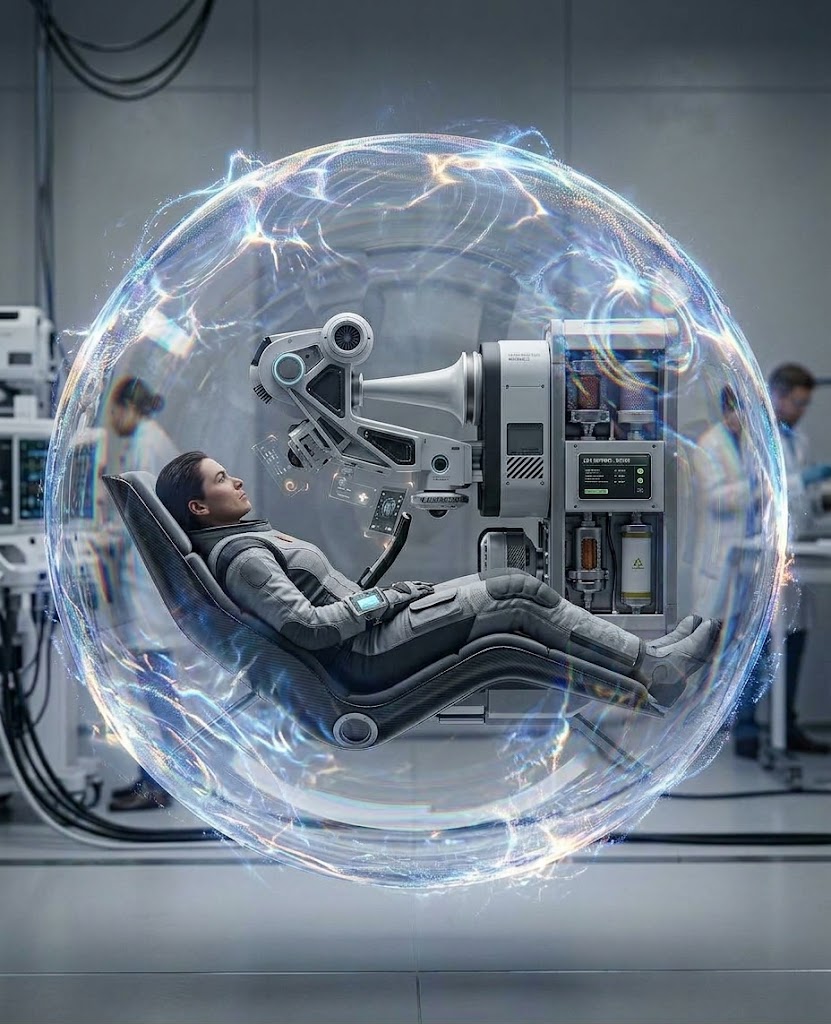
The machine itself would take the form of a layered shell of specially engineered materials surrounding a habitable interior. It would function less like a rocket engine and more like a refrigerator — not generating cold from nothing, but sorting heat from inside to outside and maintaining a statistical separation that nature would otherwise erase. In the same way, the shell would sort the vacuum’s rotational fluctuations, expelling the clockwise forward-driving variety outward while retaining and amplifying the counterclockwise backward-driving variety within the shell itself. Materials capable of responding differently to clockwise and counterclockwise fluctuations already exist in laboratories today in early form — chiral metamaterials and helicity-selective optical cavities — and the physics underlying their behavior is well established. As the shell accumulates an increasingly pure concentration of counterclockwise fluctuations, the local balance of time shifts, and the interior becomes a region where the forward march of time is dramatically slowed relative to the outside world. The greater the purity of the counterclockwise dominance achieved, the more extreme the time dilation becomes — and crucially, this scaling requires statistical refinement rather than additional raw energy.
The traveler inside experiences this as perfectly ordinary time — one hour passes, they age one hour, nothing feels unusual. But outside the shell, because the vacuum’s normal clockwise dominance has been locally disrupted, the exterior world races ahead. A decade could pass while the traveler reads a book. When the shell is switched off and the traveler steps out, they have leapt ten years into the future without moving an inch through space, without approaching a black hole, and without consuming the energy output of a civilization. The machine remains anchored to Earth throughout, solving one of the most overlooked practical problems in time travel theory. The energy cost is not the cost of generating the time dilation effect — the vacuum generates it freely — but only the modest cost of maintaining the sorted separation of fluctuations against nature’s tendency to re-mix them. The framework suggests that significant future time travel may not require unimaginable energy sources at all, but only a precise enough understanding of the vacuum to ask it, deliberately and carefully, to do what it already does everywhere and always — just sorted, rather than mixed.