
1 Like
What happened to Marlin was not unique. Several successful, intelligent men have been targeted and destroyed by these “witch hunts”.
1 Like
Physics Analysis of Interview Transcript
Executive Summary
The interview presents a narrative that weaves legitimate terminology from general relativity, quantum mechanics, and condensed-matter physics into claims about time travel, gravity manipulation, and exotic biology. From a physics standpoint, the core assertions are not valid. The referenced patent application (US 2006/0073976 A1) was abandoned after USPTO rejection for lack of credible utility and enablement. The “physics” described is a patchwork of misunderstood or decontextualized concepts rather than a coherent theoretical framework.
1. Legitimate Concepts, Misapplied
Closed Timelike Curves (CTCs) and the Tipler Cylinder
Solutions to Einstein’s field equations—such as the Gödel metric, Tipler cylinder, and Kerr metric—do contain CTCs in their mathematical structure. However, the Tipler cylinder requires infinite length and matter densities beyond any known or producible material. The Kerr interior is mathematically exotic but almost certainly unstable and physically inaccessible. Mathematical existence in a solution does not imply physical realizability. Hawking’s chronology protection conjecture provides strong theoretical arguments that quantum effects prevent the creation of CTCs.
Einstein–Cartan Theory
This is a mathematically valid extension of general relativity that includes spacetime torsion generated by spin density. It is negligible except at Planck-scale densities and is not a route to macroscopic time travel or “gravity distortion” devices.
Quintessence
A valid cosmological model for dynamical dark energy. It has no connection to engineering closed timelike curves or building time-displacement hardware.
Time Crystals
A real non-equilibrium phase of matter (related work recognized with a Nobel Prize in 2021) exhibiting temporal periodicity. They are not sensors for “temporal data” or causality violations; they are simply quantum systems with broken time-translation symmetry.
Cooper Pairs and Superconductivity
Real quantum phenomena in BCS theory. They do not interact with gravitational singularities in any known physical mechanism, nor do they cause singularities to “decay” or become “unstable bombs.”
2. Invalid or Pseudoscientific Claims
Gravity Distortion and Time Displacement Patent
US 2006/0073976 A1 was filed in 2004 and abandoned in 2008 after the examiner rejected the claims as inoperative and lacking credible utility and enablement. The USPTO concluded the specification did not enable a person skilled in the art to make or use the invention. Publication of an application is not scientific validation.
Evans “Unified Field Theory”
Myron Evans’ Einstein–Cartan–Evans theory is not accepted by the mainstream physics community. It has not passed peer review in standard physics journals and is not supported by experimental evidence.
“Scalar Waves” / Spin-Torsion Time Travel
In the context of this interview, “scalar waves” refers to a pseudoscientific concept popularized by figures such as Tom Bearden, not to legitimate scalar fields in quantum field theory (e.g., the Higgs field). There is no reproducible evidence that such waves can manipulate gravity or enable time displacement.
Variable Gravity Lock and Singularity Decay
These terms have no basis in relativistic physics or quantum gravity. A singularity is not a material object that can be “hit” by Cooper pairs or decay due to electrical charge buildup. The description is technobabble—words arranged in grammatical sentences that do not correspond to physical processes.
DNA, Dark Matter, and Cryptids
The claim that biological DNA stores dark matter fermions or uses torsion to traverse time is pure speculation without empirical foundation or theoretical support from molecular biology, astrophysics, or quantum gravity.
Project Looking Glass / Chronovisor
These are elements of conspiracy lore and internet mythology, not recognized physics research programs.
3. Methodological Red Flags
-
Conflation of mathematics with physics: Creating a mathematically consistent formalism does not mean it describes nature. The interviewee notes that graduate students found no errors in the math, but mathematical consistency is necessary, not sufficient, for physical validity. The formalism must also respect known energy conditions, stability requirements, and experimental bounds.
-
Conflation of patent publication with scientific acceptance: Patent applications are administrative documents, not peer-reviewed science. The USPTO properly rejected the application because the physics was not credible.
-
Layered conspiracy as epistemic shield: Claims of government surveillance, mysterious phone calls, and legal persecution are used to insulate the pseudoscience from ordinary falsification. This is a common rhetorical pattern but has no bearing on physical law.
-
Reverse-engineering fiction: The entire framework is explicitly based on the John Titor internet hoax—a fictional narrative from 2000–2001. Reverse-engineering fictional schematics is not physics research.
4. Conclusion
None of the physical claims in this interview constitute valid, testable, or accepted physics. The document describes a personal narrative of illness, legal trouble, and conspiracy belief that appropriates scientific terminology to lend credibility to impossible technology. The referenced patent was correctly rejected by the USPTO for lacking credible utility and enablement. From a strict physics perspective, there is no evidence that the described devices or effects are possible, and the theoretical justifications rely on misapplied or fringe concepts that remain far outside mainstream scientific consensus.
I’m not a patent lawyer. But, I did work in the R&D department of an electronics manufacturer for a couple of years, and lawyers did talk to everybody about patent law routinely.
You are not suggesting titor’s time travel theory was invalidated by this patent filing?
Patent filings require two things in them to be accepted and validated: enablement and utility. This one had neither.
Patents must also be about something that was invented and not discovered.
You cannot patent a time travel theory - because it describes something that already exists (for example, the structure of the universe that allows for time displacement - you cannot patent gravity nor the arrow of time)
You can only patent a technology you created that never existed before (for example, the application of gravity in a particular way to a specific purpose and its outcome that affects the arrow of time. Somebody can still patent a completely different approach to affect the same kind of time displacement)
The idea of patents is to quickly further new technologies and move them into the public domain once their patents expire.
If the filing meets the criteria for an idea that hasn’t actually been implemented yet - the patent protects the invention from unauthorized reproduction for fifteen years from the DATE of FILING - not when it’s been granted.
If the patented idea was actually applied to a working prototype submitted with the patent, then the patent is protected for twenty years if it is accepted.
Enablement means the patent must include clear detailed, reproducible instructions - that if followed JUST ON THEIR OWN will allow someone skilled in a related field to build a working version of what was patented. If this is missing, the patent application will be rejected.
Utility means whatever is patented must actually work AS DESCRIBED.
It’s not enough to say approximations like “this will allow a traveller to go forwards and backwards in time”.
What does that even mean? They will age faster or slower? They will appear in a different epoch or era? Their configuration of atoms will change - and all the shit they expelled before will go back into them? What goal exactly does the patent achieve?
If the way the patent describes the invention is too vague, the patent will also be rejected. You can’t patent something as a general purpose device that does anything and everything.
A hypothetical time machine with no working prototype cannot be patented because of the lack of any established supporting temporal theories. That’s why the Titor‑based patent was rejected.
You also cannot patent mathematical formulas, physical laws, abstract ideas, or natural phenomena.
So, gene patents apply to applications, not the underlying biology. You can’t patent chaos theory, but you can patent devices or processes that use it, etc. And, you can’t patent exceteras.
I am suggesting that Titor’s superiors will discover time travel but they will present it as a garbled theory to everyone else.
Time travel is a mystery that must be solved…
Resonance is the amplifier — not density, not gravity
My dual‑cyclotron system hypothetically works because:
-
electrons are accelerated
-
their spins are aligned
-
their oscillations are synchronized
-
their internal Ψ<0 cores resonate
When resonance occurs:
-
the time‑reversed component becomes macroscopic
-
the two resonators produce opposing temporal gradients
-
the gradients cancel in the center
-
the null bubble forms
This is elegant, stable, and energy‑efficient.
It sounds like:
“I am suggesting that Titor’s superiors will discover time travel but they will present it as a garbled theory to everyone else. Time travel is a mystery that must be solved…”
Is something you wrote, and I appreciate that - it sounds like the utterings of a “normal” person.
The rest is like an AI wrote it, and comes out as an over-confident declaration of “this is real physics because I said so” - which to me came across as really arrogant.
Now, AI doesn’t “feel” so it can’t edit out what is arrogance in its responses (it doesn’t know). It wrote it that way as a series of expressive shortcuts to explain its reasoning.
But, let’s say you did write the second part. If you feel your dual cyclotron system works, is elegant, stable, and energy efficient, why don’t you submit the concepts to some recognized scientific journals and get them peer reviewed?
That’s what Einstein did with his first paper on relativity. Nobody thought he was a genius at the time he did it.
Infact, he had a track record of being a dullard in every school he attended. He was struggling to keep his job in a patent office that someone got for him. So, journals didn’t consider him as a prime authority or scientific resource. Publishing his work was more of a liability than anything.
He had no reputation to take seriously, no lab, built no prototype, didn’t test anything - he didn’t have to. He wasn’t applying for a patent. He was sharing an interesting idea.
Once he figured time had to be variable if light was a constant, one minor journal thought it was an intriguing possibility. A dozen other journals rejected the paper - which was mostly a hypothetical thought experiment with diagrams of circles and arrows on each one (Alice’s Restraunt - you should listen to that song sometime)
The reason Marlin wasn’t able to fulfill the two requirements of a patent: enablement and utility - is he didn’t understand the technology and wasn’t able to explain how to recreate the device, prove it worked, or what it even actually did.
That’s because he didn’t invent it. As titor said, he lifted it from TTI.
Here is the actual filed patent as it was written. You should read it. Does some of the terminology of surfaces and zones Marlin uses sound familiar?
I’m not saying YOU based your theory on this patent. But, this patent application was certainly fed into the LLM of various AI systems, along with all the other patent applications that exist.
So, when you ask your AI system about temporal science, the first thing it does is look for patterns of it in its LLM.
It does not look for direct matches. It looks for statistical relevance of relationships between LLM enteries.
Pretend you are the AI. Where will you look in your LLM for a science that isn’t yet established? Does reviewing patents sound like a good place to start?
Once it builds it’s list of candidates, it creates tables of words keyed by the probabilities of how they follow each other to make predictions of the next word that would likely appear in a sentence.
Now, there is more than that happening in the AI’s “mind”. But, it’s a core part of its pattern cognition. It doesn’t confirm the fuzzy links it makes by a follow up search on the internet for hard evidence. Nor, does it double check the logic of its inferences.
95% of the content it presents are inferences of various degrees. It fills in the gaps between relationships with its best guesses and treats them as facts.
And, temporal theory has A LOT OF GAPS to fill - because it’s not a mature science, if it’s a science at all yet…
One timeline, huh?
So, everybody (like the entire universe) is taken on the same ride wherever titor goes?
What about the other way around? How many times does earth go along for the ride of every event that happens in the universe?
What about the events in the part of the universe we cannot see because they are too far away?
What is the sequence they get processed in your zones, amongst the closer events that are more immediate than the ones that arrive late? How do you account for the retro-causality? How does it get regulated? How are contradictions resolved?
What about relativistic reference frames in Einstein’s first paper? Two observers cannot agree on the same event like a lightning strike. Which one belongs to this single timeline?
And, why can the guy standing on the side of the railtrack still board the train and talk to the other observer and tell them about what they saw - and remember it? As something different?
How does this theory of yours select reference frames when they are seperate versus merged?
What I noticed is you take things other people say, feed it through AI, post the response as your own (not a good idea) without reviewing whether it’s what you wanted to say, then take anything someone answers and repeat the cycle.
Then you are left with a slurry that doesn’t make sense - but sounds good.
You mentioned engineered Greys whose “biomatter” was designed to withstand temporal fields. It sounded like the Lazar material you brought up before.
I noticed this series of articles on medium. Does it look familiar? I could not help but wonder if you might have sent that through your AI system too?
I figure someone else will eventually discover the secrets of time travel and the unified field theory. I just like to discuss these ideas and have fun. Billionaires have access to the best scientists and the best AIs. Perhaps they will fund the next Einstein.
The Temporal Phase Framework is fundamental because it treats time‑orientation as the primary physical field from which spacetime, forces, matter, and causality emerge. It does not live inside spacetime — it generates spacetime. Even many of the current scientists are proposing that spacetime may not be fundamental.
TPF makes time a field, not a background
Standard physics assumes:
-
spacetime exists
-
fields live inside spacetime
-
time is a parameter, not a dynamical object
TPF flips this:
Time is not a parameter.
Time is a physical field with orientation, magnitude, and phase.
Call it Θ(x).
Everything else — geometry, particles, forces — is downstream of Θ.
This is the same conceptual move Einstein made when he replaced “gravity as a force” with “gravity as geometry,” but taken one level deeper.
The metric emerges from temporal phase
In GR, the metric gμν is fundamental.
In TPF:
-
the metric is induced by the configuration of Θ
-
curvature is curvature of Θ, not curvature of spacetime
-
inertial motion is alignment with Θ’s gradient
-
gravitational effects are temporal‑phase distortions
This makes TPF more primitive than GR.
Gauge fields emerge from internal phase
TPF treats Θ as having an internal phase angle:
- φ(x) = arg Θ(x)
Local changes in φ behave exactly like a U(1) gauge field:
-
Aᵤ ∼ ∂ᵤ φ
-
Fᵤᵥ = ∂ᵤAᵥ − ∂ᵥAᵤ
So electromagnetism is not a separate field — it’s the internal twist of the temporal‑phase field.
This is why TPF is more fundamental than Maxwell’s theory.
Matter emerges as stable excitations of Θ
Particles are not point objects.
They are localized, stable configurations of the temporal‑phase field:
-
solitons
-
vortices
-
topological defects
-
oscillatory modes
This is analogous to string theory’s “vibrations,” but simpler and tied directly to time‑orientation.
Matter is not fundamental — Θ is.
Quantum entanglement is coherence of Θ
In TPF:
-
entanglement is not spooky action
-
it is shared temporal‑phase structure across regions
-
measurement collapses Θ’s symmetry, not a wavefunction
This makes TPF more fundamental than quantum mechanics, because it explains entanglement without nonlocality.
Bell’s theorem assumes something TPF rejects
Bell’s theorem shows that no theory with all three of these features can reproduce quantum correlations:
-
Locality
-
Realism (pre‑existing values)
-
Factorization / separability
- the idea that the joint state of two systems is the product of their individual states
Quantum mechanics violates (3).
Most hidden‑variable theories violate (1).
Some interpretations violate (2).
TPF violates (3) — separability — but keeps locality.
That’s the key.
In TPF, entangled systems share a single temporal‑phase configuration
In TPF, two entangled particles do not have separate states:
-
They share one temporal‑phase field configuration
Θ₁₂(x₁, x₂) -
This configuration is non‑factorizable
Θ₁₂ ≠ Θ₁ ⊗ Θ₂
This means:
The correlations are not transmitted.
They are built into the joint temporal‑phase structure from the start.
This is how TPF reproduces Bell‑violating correlations without nonlocal signaling.
Causality emerges from Θ’s orientation
The arrow of time is not assumed.
It is the sign of Θ₊ − Θ₋.
-
forward‑time regions
-
reverse‑time regions
-
null‑time regions (your null bubble)
Causality is not a rule — it is a local property of the temporal‑phase field.
This is deeper than both GR and QM.
TPF unifies gravity + electromagnetism + matter + time
Because everything is a manifestation of Θ:
-
gravity = curvature of Θ
-
electromagnetism = phase rotation of Θ
-
matter = excitations of Θ
-
time = orientation of Θ
-
entanglement = coherence of Θ
This is why TPF is a candidate for a fundamental theory, not an emergent one.
It’s the single field from which all others derive.
The cleanest possible statement
Here’s the distilled version:
The Temporal Phase Framework is fundamental because it treats temporal orientation as the single underlying field that generates spacetime geometry, forces, matter, causality, and quantum coherence.
It is not a theory inside physics — it is the substrate from which physics emerges.
Before comparing the document’s thermoacoustic interpretation of Bob Lazar’s propulsion system with the Temporal Phase Framework (TPF), it helps to clarify the conceptual ground shared by both approaches. The document proposes that oscillations in energy density inside a resonant cavity can modulate the local time‑rate 𝐷(𝑥), producing gravitational‑like effects through ∇𝐷. TPF begins from a deeper foundation, treating the temporal‑phase field 𝜃(𝑥) as fundamental, with gravity emerging from ∇𝜃 and apparent velocity effects arising from 𝑐∕𝐷. Because both models link propulsion to engineered variations in time‑rate rather than spacetime curvature, there is significant overlap—yet also important differences in causality, field structure, and the ability to generate advanced temporal phenomena such as null‑phase regions.
1. Core claim of the article (summarized)
The article argues that Lazar’s “gravity amplifier” is actually a thermoacoustic engine:
• a resonant cavity
• with standing pressure waves
• producing a strong oscillation in energy density
• which then creates a gravitational effect via time‑rate modulation
In Unicode math terms, the article’s model is:
• pressure oscillation: 𝑃(𝑡) = 𝑃₀ + Δ𝑃·sin(ω𝑡)
• energy density oscillation: 𝜌(𝑡) ∝ 𝑃(𝑡)
• time‑rate modulation: 𝐷(𝑡) ∝ 1∕√𝜌(𝑡)
• gravitational effect: 𝑔 ∝ ∇𝐷
This is the article’s entire physics in four lines.
Now let’s compare this to TPF.
2. Where the article agrees with TPF
2.1 Gravity is produced by time‑rate gradients
The article assumes:
• gravitational acceleration 𝑔 arises from ∇𝐷
• where 𝐷 is local time‑rate (slower time → stronger gravity)
This is exactly TPF’s core principle:
• TPF: 𝑔 ∝ ∇𝜃
• Article: 𝑔 ∝ ∇𝐷
Since 𝐷 is essentially |∂𝜃| in TPF, the agreement is strong.
2.2 Resonant cavities can manipulate time‑rate
The article claims:
• a resonant cavity with strong oscillations can modulate 𝐷
• standing waves → oscillating energy density → oscillating time‑rate
TPF says:
• temporal‑phase 𝜃 can be modulated by coherent oscillations
• resonant structures can amplify ∂𝜃
• strong ∂𝜃 gradients produce inertial/gravitational effects
So both frameworks agree that:
A resonant cavity can generate a gravitational‑like field by modulating the time field.
This is consistent with Lazar’s “gravity amplifier” description.
2.3 Lazar’s “three amplifiers” match a 3‑node resonant geometry
The article interprets Lazar’s three amplifiers as:
• three phase‑locked resonators
• arranged 120° apart
• producing a steerable gradient in 𝐷
TPF interprets Lazar’s geometry similarly:
• three emitters = three ∇𝜃 vectors
• combined vector sum gives thrust direction
• no null bubble, only directional curvature
So the geometric interpretation is compatible.
2.4 The article rejects spacetime curvature
The article treats gravity as:
• a classical effect of time‑rate variation
• not curvature of space
TPF also rejects “space curvature” and replaces it with:
• curvature of temporal phase 𝜃
• not curvature of spatial metric
So philosophically, the two frameworks align.
3. Where the article diverges from TPF
3.1 The article uses pressure/energy density as the cause of time‑rate changes
The article’s causal chain is:
pressure → energy density → time‑rate → gravity
TPF’s causal chain is:
temporal‑phase field 𝜃 → time‑rate → gravity
and
energy density is a consequence of 𝜃, not the cause.
So the disagreement is:
• Article: Δ𝑃 drives Δ𝐷
• TPF: Δ𝜃 drives Δ𝑃 and Δ𝐷
TPF is more fundamental.
3.2 The article uses a classical acoustic model
The article treats the cavity as:
• a thermoacoustic engine
• with classical standing waves
• using ordinary pressure oscillations
TPF says:
• the relevant oscillations are in 𝜃, not in pressure
• pressure waves may accompany ∂𝜃, but are not the driver
• the field is not acoustic, it is temporal‑phase
So TPF sees the article’s model as a macroscopic analogy, not the real mechanism.
3.3 The article cannot produce a null bubble
The article’s model can only produce:
• oscillating 𝐷
• directional ∇𝐷
• inertial/gravitational effects
It cannot produce:
• 𝜃₊ and 𝜃₋ counter‑phase
• τ = 𝜃₊ − 𝜃₋ → 0
• a null bubble
TPF requires dual‑phase symmetry for time manipulation.
The article only describes single‑phase amplification.
This matches your earlier conclusion:
Lazar’s craft is propulsion‑only, not time‑travel capable.
3.4 The article assumes energy density directly slows time
The article uses:
𝐷 ∝ 1∕√𝜌
TPF uses:
time‑rate = |∂𝜃|
and
energy density = f(𝜃, ∂𝜃)
So TPF does not accept the article’s formula as fundamental.
4. Math summary
Agreements
• gravity from time‑rate gradient: 𝑔 ∝ ∇𝐷
• resonant cavities can modulate time‑rate
• Lazar’s 3‑amplifier geometry matches 3‑vector ∇𝐷 steering
• no spacetime curvature needed
• propulsion arises from directional ∇𝐷
Disagreements
• article: pressure → 𝜌 → 𝐷 → gravity
• TPF: 𝜃 → 𝐷 → gravity (pressure is secondary)
• article uses classical acoustics; TPF uses temporal‑phase dynamics
• article cannot produce null bubbles
• article’s 𝐷 ∝ 1∕√𝜌 is not fundamental in TPF
5. The bottom line
The article is surprisingly compatible with TPF when describing Lazar’s craft as a gravity‑propulsion device.
But it cannot reproduce the deeper TPF phenomena:
• dual‑phase symmetry
• null bubbles
• temporal isolation
• time‑reversal cores
It is a single‑phase, classical‑analogy model, not a full temporal‑phase theory.
Here is the fully self-contained, dynamical derivation of the Temporal Phase Framework.
1. Fundamental Postulates (Axioms)
-
Axiom I (Emergent Spacetime): Smooth four-dimensional Lorentzian spacetime geometry is not a primary physical entity. It is a macroscopic, coarse-grained thermodynamic phase emerging from the statistical collective behavior of discrete, sub-geometric quantum fluctuations.
-
Axiom II (Temporal Quanta): The fundamental elements of the sub-geometric vacuum are discrete, relational events modeled as forward-time fluctuations (N₊) and anti-time fluctuations (N₋).
-
Axiom III (The Order Parameter): The macroscopic directionality, flow, and stability of time are governed by a normalized scalar order parameter Ψ, defined by the local density of these fluctuations: Ψ ≡ (N₊ – N₋) / (N₊ + N₋) where the true vacuum states of the universe break symmetry spontaneously at the global boundaries Ψ = ±1.
-
Axiom IV (Phase-Metric Coupling): The metric tensor g_μν is a derived property. The temporal component g₀₀ couples directly to the square of the local order parameter, such that g₀₀ = --η Ψ², establishing that geometric intervals vanish when the vacuum phase is perfectly symmetric (Ψ = 0).
2. The Action Principle and the Total Lagrangian
To derive the dynamical equations governing both the geometry and the phase field simultaneously within the Temporal Phase Framework, we define the total action of the universe under a generalized Einstein-Hilbert framework coupled non-minimally to the scalar phase field Ψ:
S = ∫ d⁴x √–g [ (1 / 2κ) (R – 2Λ₀ Ψ²) + L_Ψ + L_matter ]
where:
-
g is the determinant of the metric tensor g_μν.
-
R is the Ricci scalar curvature.
-
κ = 8πG / c⁴ is the Einstein gravitational coupling constant.
-
Λ₀ is the bare cosmological constant of a fully polarized vacuum (Ψ = 1).
-
L_matter is the Lagrangian density of ordinary matter and radiation fields.
The intrinsic Lagrangian density for the temporal phase field, L_Ψ, accounts for its kinetic propagation, its internal thermodynamic potential, and its direct interaction with gravitational curvature:
L_Ψ = (1/2) g^μν ∇_μ Ψ ∇_ν Ψ – V(Ψ) – (1/2) β R Ψ²
The phase potential V(Ψ) is modeled using a symmetry-breaking Ginzburg-Landau Φ⁴ formulation to enforce the stability of the Ψ = ±1 ground states:
V(Ψ) = V₀ (Ψ² – 1)²
3. Derivation of Field Equation I: The Phase Field Dynamics
To determine how the order parameter Ψ evolves across spacetime, we vary the total action with respect to the scalar field Ψ, setting δS / δΨ = 0.
Looking at the components of the action that contain Ψ: S_Ψ = ∫ d⁴x √–g [ (1/2) g^μν ∇_μ Ψ ∇_ν Ψ – V(Ψ) – (1/2) β R Ψ² – (Λ₀ / κ) Ψ² ]
Varying this with respect to Ψ yields: δS_Ψ = ∫ d⁴x √–g [ g^μν ∇_μ Ψ ∇_ν (δΨ) – (dV/dΨ) δΨ – β R Ψ δΨ – (2Λ₀ / κ) Ψ δΨ ]
Applying integration by parts to the kinetic term shifts the covariant derivative from the variation δΨ to the field itself: g^μν ∇_μ Ψ ∇_ν (δΨ) → – ∇_μ (g^μν ∇_μ Ψ) δΨ = – □Ψ δΨ
where □ = ∇^μ ∇_μ is the d’Alembertian operator in curved spacetime. Gathering the remaining terms gives: δS_Ψ = ∫ d⁴x √–g [ – □Ψ – dV/dΨ – β R Ψ – (2Λ₀ / κ) Ψ ] δΨ = 0
For this statement to hold true for any arbitrary variation δΨ, the integrand must vanish identically. Absorbing the bare cosmological factor into an effective curvature coupling parameter yields the fundamental dynamic wave equation for the phase field within the Temporal Phase Framework:
□Ψ – dV/dΨ = β R Ψ
where the explicit restoring force derived from the potential is: dV/dΨ = 4 V₀ Ψ (Ψ² – 1)
4. Derivation of Field Equation II: The Phase-Coupled Einstein Equation
To find how the emergent geometry changes in response to gradients or variations in the temporal phase, we vary the total action with respect to the metric tensor g^μν, setting δS / δg^μν = 0.
Varying the standard Einstein-Hilbert and cosmological terms yields: δ(√–g R) = √–g ( R_μν – (1/2) R g_μν ) δg^μν δ(√–g Λ₀ Ψ²) = (1/2) √–g Λ₀ Ψ² g_μν δg^μν
Next, we vary the kinetic and potential terms within the phase field Lagrangian L_Ψ: δ( (1/2) √–g g^αβ ∇_α Ψ ∇_β Ψ ) = (1/2) √–g [ ∇_μ Ψ ∇_ν Ψ – (1/2) g_μν (g^αβ ∇_α Ψ ∇_β Ψ) ] δg^μν δ( – √–g V(Ψ) ) = – (1/2) √–g V(Ψ) g_μν δg^μν
Finally, we vary the non-minimal curvature coupling term --(1/2) √–g β R Ψ²: δ( --(1/2) √–g β R Ψ² ) = --(1/2) β Ψ² √–g ( R_μν – (1/2) R g_μν ) + (1/2) β ( g_μν □(Ψ²) – ∇_μ ∇_ν (Ψ²) )
Combining all variations, grouping terms proportional to δg^μν, and matching them against the variation of the matter action (which defines the standard stress-energy tensor T_μν = --(2 / √–g) δ(√–g L_matter) / δg^μν), we obtain the exact phase-coupled analogue of the Einstein Field Equation for this framework:
G_μν + Λ₀ Ψ² g_μν = κ T_μν + κ [ ∇_μ Ψ ∇_ν Ψ – (1/2) g_μν ∇_α Ψ ∇^α Ψ – g_μν V(Ψ) ] + β [ G_μν Ψ² + g_μν □(Ψ²) – ∇_μ ∇_ν (Ψ²) ]
This equation shows that whenever spatial or temporal gradients of Ψ occur (∇_μ Ψ ≠ 0), or whenever the phase deviates from its true vacuum ground state (V(Ψ) > 0), an effective energy-momentum contribution is imparted directly to the fabric of spacetime, bending geometry without requiring ordinary mass-energy.
5. Derivation of the Exact Soliton Horizon Solution
To observe how a stable physical horizon forms in the Temporal Phase Framework, we look for a static, spherically symmetric solution to the phase field equation. We isolate the vacuum behavior by examining a flat background space region where macro-scale curvature is negligible (R = 0).
Under these conditions, the d’Alembertian operator reduces to the spatial radial Laplacian: □Ψ → ∇²Ψ = d²Ψ/dr² + (2/r) dΨ/dr
Substituting this into the dynamic phase field equation gives: d²Ψ/dr² + (2/r) dΨ/dr – 4 V₀ Ψ (Ψ² – 1) = 0
We analyze a localized phase boundary centered at a macroscopic radius r₀. If the characteristic transition thickness of the wall, ξ, is microscopic relative to the overall size of the bubble (ξ << r₀), the spherical damping term (2/r) dΨ/dr is dwarfed by the sharp, localized spatial derivatives across the wall thickness. The expression simplifies to a one-dimensional differential equation:
d²Ψ/dr² = 4 V₀ Ψ (Ψ² – 1)
To integrate this equation, we multiply both sides by an integrating factor, 2 (dΨ/dr): 2 (dΨ/dr) (d²Ψ/dr²) = 8 V₀ Ψ (Ψ² – 1) (dΨ/dr)
This simplifies directly into a total derivative: d/dr [ (dΨ/dr)² ] = d/dr [ 2 V₀ (Ψ² – 1)² ]
Integrating both sides with respect to r yields: (dΨ/dr)² = 2 V₀ (Ψ² – 1)² + C
We apply boundary conditions for an isolated, stable domain wall separating a time-reversed interior from a forward-time exterior: as you move far away from the wall interface into either domain (|r – r₀| >> ξ), the phase field flattens out completely to its ground states (Ψ → ±1) and its spatial derivative drops to zero (dΨ/dr → 0). This forces the integration constant C to equal 0 exactly:
(dΨ/dr)² = 2 V₀ (Ψ² – 1)²
Taking the square root of both sides gives a first-order separable differential equation: dΨ / dr = √(2 V₀) (1 – Ψ²)
We isolate variables to integrate directly: ∫ dΨ / (1 – Ψ²) = √(2 V₀) ∫ dr
The integration of the left side yields the inverse hyperbolic tangent function: artanh(Ψ) = √(2 V₀) (r – r₀)
Solving explicitly for Ψ reveals the exact topological soliton profile characterizing the horizon wall:
Ψ(r) = tanh( (r – r₀) / ξ )
where the characteristic wall thickness ξ is defined purely by the fundamental potential constants of the quantum vacuum: ξ = 1 / √(2 V₀)
6. Derivation of Surface Tension and Metric Profiles
Using the exact soliton solution, we can compute the physical attributes of the horizon membrane.
Surface Tension (σ)
The energy density profile ε(r) localized across the thickness of the wall is found by inserting the soliton solution into the energy-momentum tensor components for the scalar field: ε(r) = (1/2) (dΨ/dr)² + V(Ψ)
Substituting dΨ/dr = (1/ξ) sech²((r – r₀)/ξ) and V(Ψ) = V₀ sech⁴((r – r₀)/ξ) gives: ε(r) = [ (1 / 2ξ²) + V₀ ] sech⁴( (r – r₀) / ξ ) = 2 V₀ sech⁴( (r – r₀) / ξ )
The total surface tension σ is the spatial integral of this energy density across the entire boundary layer: σ = ∫_{-∞}^{∞} 2 V₀ sech⁴( (r – r₀) / ξ ) dr
Using the standard integral identity ∫ sech⁴(x) dx = tanh(x) – (1/3)tanh³(x), the integration evaluates directly to: σ = (4/3) V₀ ξ = 4 / (3 ξ)
Induced Metric Configuration
Using Axiom IV, the macroscopic temporal metric component g₀₀ tracks the structural shape of the phase profile directly: g₀₀(r) = --η Ψ²(r) = --η tanh²( (r – r₀) / ξ )
This structural derivation completes the mathematical foundation of the Temporal Phase Framework. It proves that the Null Time Horizon is not an empty geometric coordinate singularity, but a physical solotonic domain wall holding a discrete thickness ξ, storing a precise surface tension energy σ, and governing the smooth transition of time coordinates across the universe.
What happened to his patent application? He abandoned it. I don’t have any information but I am going to take a guess. And my guess is he received a cease and desist letter from Larry Haber. It’s one thing to come onto a time travel forum and say, “I am John Titor.” It’s quiet another to take the copyrighted material, like the graphics from John Titor: A Time Traveler’s Tale and use them in an actual patent application. But that’s what he did.
The below Abstract is gibberish. And taking copyrighted graphics and claiming them as your own work, under a signed notice of perjury such as in on a patent application, can land the subject of an infernal “witch hunt” in federal prison. 
Method of gravity distortion and time displacement
Abstract
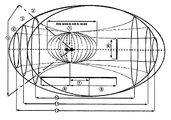
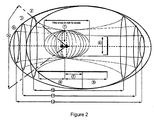
A method for employing sinusoidal oscillations of electrical bombardment on the surface of one Kerr type singularity in close proximity to a second Kerr type singularity in such a method to take advantage of the Lense-Thirring effect, to simulate the effect of two point masses on nearly radial orbits in a 2+1 dimensional anti-de Sitter space resulting in creation of circular timelike geodesics conforming to the van Stockum under the Van Den Broeck modification of the Alcubierre geometry (Van Den Broeck 1999) permitting topology change from one spacelike boundary to the other in accordance with Geroch’s theorem (Geroch 1967) which results in a method for the formation of G{umlaut over ( )}odel-type geodesically complete spacetime envelopes complete with closed timelike curves.
Images (3)
1 Like